SunChild First Regional Environmental Festival Workshops
The second part of SunChild First Regional Environmental Festival will be a meeting place for environmental key-players and organizations; individuals who are active in nature protection issues, film makers and interested citizens from the whole region. With the workshop program the organizers want to create a platform for cross bordering encounters and the creation of "environmental thought", through open disputes, training and outreach.
The workshops will be conducted by international and regional environmental experts. Overall aim of the program is to encourage public participation in environmental decision-making and cooperation for the solution of the most urgent environmental problems in the region.
The topics of the workshop program will include an ecotourism workshop as well as the presentation of advocacy campaigns and tools for network building. SunChild Festival's workshop program will be closed with a panel discussion which is open for all visitors and participants of the Festival. Experts from regional and international organizations and NGOs (for example: OSCE, WWF, CENN, UNDP) as well as representatives of governmental institutions will belong to the panel. Their discussion will focus on the question how to improve the joint regional efforts for solving the environmental problems in South Caucasus.
SunChild Ecotourism Workshop
Ecotourism is relatively a new concept in Armenia. It is based on the idea of having a voyage into nature. But ecotourism is more than just a voyage into nature; it includes all sides of life: wildlife and nature, biodiversity, preservation of the environment, customs and traditions, culture, society and humankind. Ecotourism is a voyage to those places, where pure nature, more or less, is still preserved. These kinds of trips do not disturb the unity of eco-systems and aim to teach about the natural and ethno-cultural uniqueness of each specific location. Simultaneously, ecotourism serves as a mean to make the preservation of the environment profitable for the local people. Thus ecotourism is a type of tourism based on nature and dedicated to its restoration.
Central topics of SunChild Ecotourism Workshop
-
What is Sustainable Tourism and how does it differ from Eco-tourism?
-
Sustainable tourism in Armenia and the south Caucasus region: prospects, potential, obstacles.
-
The benefits of ecotourism for the development of local infrastructure
Workshop advisors
SunChild Networking Workshop
The organizers of SunChild Festival, in their former work, identified a lack of cooperation among South Caucasus NGOs as well as between them and international environmental organizations. Due to this fact the gaining and spreading of information about environmental issues is very much hampered in the region. Moreover many regional environmental NGOs are lacking the necessary skills to establish sustainable relations with the corresponding state structures in their countries.
A result of these shortcomings is that the regional NGOs have still not succeeded to initiate an effective cross-border environmental movement. Thus the implementation of SunChild Festival and specially the networking workshop in the framework of the festival's program will bring an opportunity for environmental organizations, professionals and NGOs to network and cooperate with one another. The networking workshop aims to offer environmental experts and representatives from various South Caucasian NGOs an opportunity to exchange their views, gain practical tools, hear success stories, and become aware of effective advocacy campaigns. Under supervision of trainers/ activists of well-known environmental organizations in the region and from abroad the participants will be empowered to develop sustainable concepts for cooperation and future joint projects within the region.
Central Topics of SunChild Networking Workshop
-
Advocacy: How can individuals/organizations participate in the discussion and influence decisions about environmental issues in the fields of politics, legislation and society?
-
Coalition Building: How can individuals/ organizations join and cooperate in order to launch effective advocacy campaigns for concrete environmental issues and the protection of social environmental interests?
-
Networking: How can individuals/ organizations build sustainable networks which offer the possibility to distribute information quickly with one another and thus react flexible and cooperatively to any arising environmental problem?
Workshop Advisors
Representative of Armenia Tree Project (ATP) Charitable Foundation Armenia Tree Project (ATP), a Diaspora-supported non-profit organization based in Watertown and Yerevan, conducts vitally important environmental projects in Armenia's impoverished and deforested zones and seeks support in advancing its reforestation mission. Since 1994, ATP has made enormous strides in combating desertification in the biologically diverse but threatened Caucasus region. To enhance public awareness of Armenia's critical environmental challenges, ATP co-produced, with several partner organizations, a series of documentary films presented publicly in Armenia and abroad, aired on TV and viewable online at ATP's website www.ArmeniaTree.org.
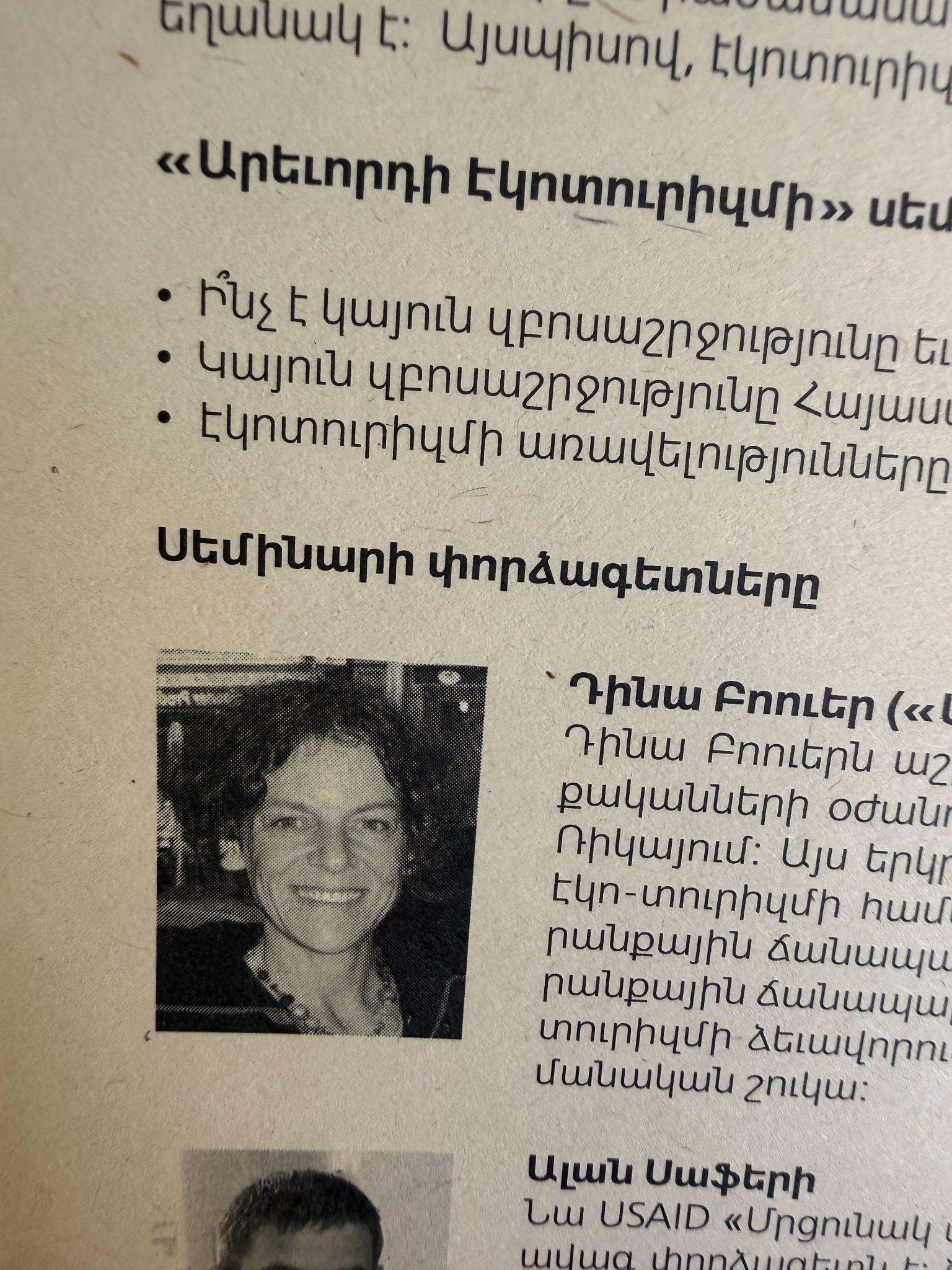
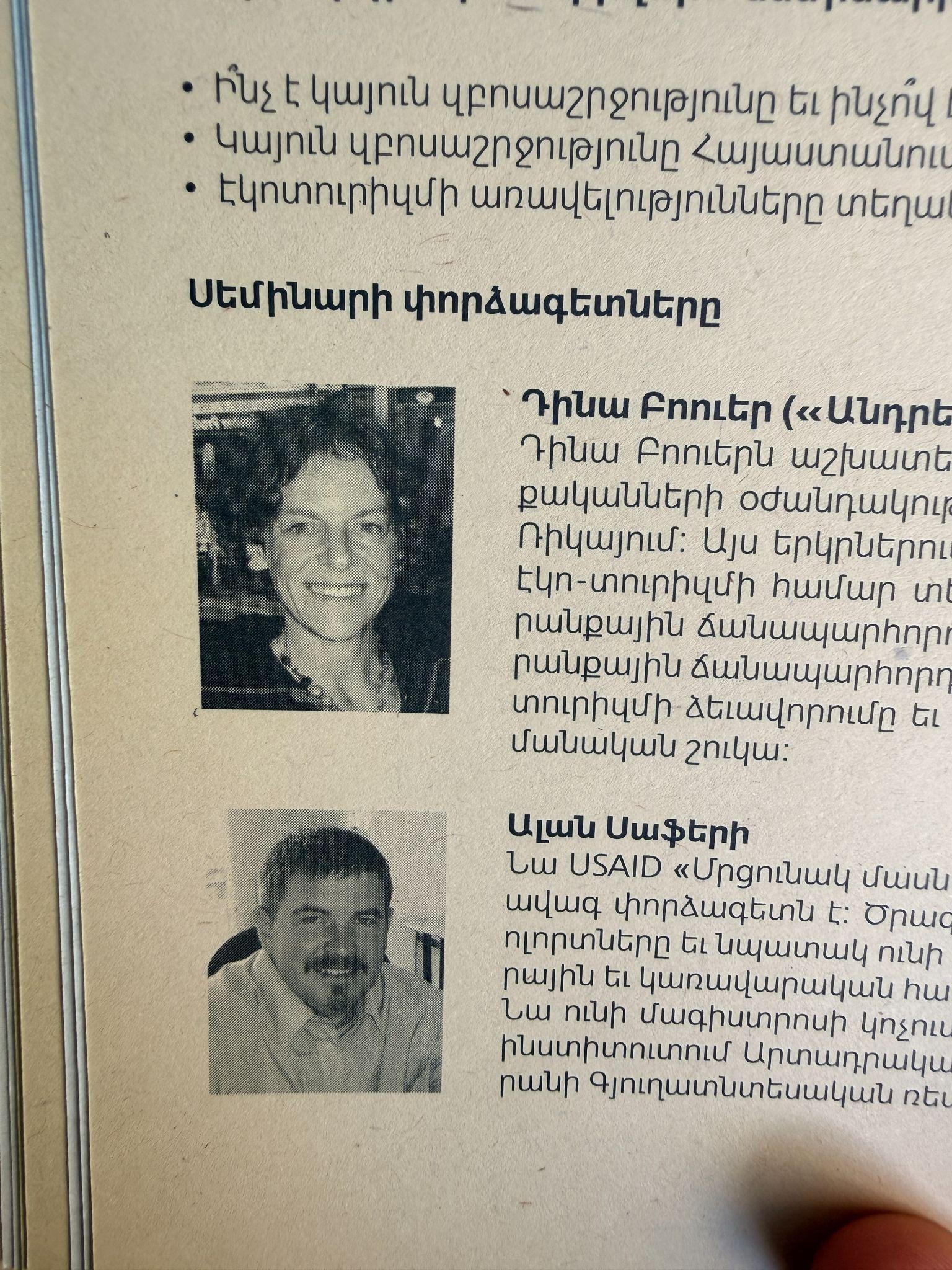
Karen Manvelian (Head of the Yerevan office of World Wide Fund for Nature /WWF) One of the successful advocacy campaigns which will be introduced to the participants is the Shikahogh Forest Campaign. In 2005 several Armenian environmental organizations succeeded in forcing the government to give up plans to cut Shikahogh forest for a highway project. The campaign was initiated by WWF Armenia and organized by ATP in cooperation with other NGOs.
Aida Iskoyan (Environmental Public Advocacy Center / EPAC) Aida Iskoyan will inform the workshop participants about the Aarhus Convention and the possibilities it offers to influence the decision making processes in the field of environmental law. Also Aida Iskoyan will introduce the advocacy campaign launched by EPAC which succeeded to convince Armenian government to adopt the Aarhus Convention.
Mariam Tevzadze (Caucasus Environmental NGO Network /CENN) Mariam Tevzadze (Biologist, CENN Information officer) will introduce to the workshop participants the work and projects of CENN. CENN is a non-governmental, regional organization established in 1998 and specialized in the fields of civil society development and institutional strengthening, environmental policy, resources management, compliance management and communication and environment. Since its establishment, CENN has worked at the local, national and regional levels in the Caucasus region. CENN has around 10 years of experience in delivering modern solutions for public and business sectors as well as communities, assisting them in managing their environmental and related risks and helping them achieve competitive advantage through improved environmental and social performance.
List of the production companies of the environmental films included in the festival program
Akademi Production was established in 1992 upon the initiative of four faculty members from the Communications Faculty of the Anadolu University. The company produces documentary films and aims to increase documentary production in Turkey.
ARMNA production company was founded in 2002. It is specialized on the production of videos, educational and documentary films. In 2006 the film "The Inhabitants of Forbidden Islands" (director H. Hakobyan) won first prize in "Armenian Panorama" section of Yerevan International Film Festival "Golden Apricot".
AVE Film Association produces documentaries and TV programs. Among them environmental documentaries about: water and biodiversity conservation along Danube river, vine making in Moldova, Kozlodui nuclear wasting transit through Moldovan railways, human migration and trafficking.
Bionaut Films is a Prague based production company founded in 1999. The company produces features, documentaries and animation. It has won numerous international awards.
Dogabel is the first non-governmental organization in Turkey, working in the field of documentary film making and photography for the protection of the important natural habitats and their biodiversity.
ELM MEDIA was founded in 2005 with the aim of drawing society's attention to environmental and social issues through documentaries and photographic projects and exhibitions. The aim of the company is to encourage people to think about the interaction between humans and nature, the possibilities of co-existence between different groups in society and key moments in the history of countries and nations.
Established in 2000, Kutup Ayisi Documentary Productions produces quality documentary films and promotional films. Based in Istanbul, Kutup Ayisi is a specialty documentary film production company focusing on making strong, challenging documentaries with international interest, shot in some of the most colourful and inviting locations in Anatolia.
Falkor I.C.Y. (NGO) is constructing and supporting an international network of youth protecting the environment, supporting and developing independent media and is active in human rights, anti-racism, pro-tolerance issues and development of civil society in general.
Greenpeace unites people of all nations, colors and languages. We all share a passion, which became our profession and a mission—to ensure the ability of the earth to nurture life in all its diversity. From the very beginning of its campaigning up to this day Greenpeace has strictly adhered to these principles. A Greenpeace office was established in Russia in 1989 and since 1992 it was given the name Greenpeace Russia.
LES FILMS DU TRICYCLE. The film-production company, Les Films du Tricycle, was founded in 1991 by Sylvain L'Esperance, Lucie Lambert and Pierre Marier, who are all producers and directors. Les Films du Tricycle productions clearly assert a will to make documentary film and filmmaking a space for reflection and artistic expression dedicated primarily to human beings and their destiny.
Manana Youth cultural-educational centre was founded in 1995 and it is already 12 years it works in youth media education sphere. The centre runs studios for young journalists, filmmakers, photographers and animators.
Milieukontakt Oost-Europa supports ecological sustainability in the countries of Europe and Asia. In 1988 Milieukontakt was founded by, amongst others, Friends of the Earth International (FoEI), Milieudefensie (Friends of the Earth Netherlands) and Stichting Natuur en Milieu (Dutch Foundation for Nature and Environment).
Neshneh-Rooz Company's activities started from year 2000. The company made fifteen short films (fiction, documentary and animation) on 16mm and video. Since last year the films produced by the company participate at international festivals.
SGU TV, Satellite TV channel (education and culture), production and broadcast.
The Foundation for the Preservation of Wildlife and Cultural Assets in the Republic of Armenia (FPWC) was established in 2001. It produced environmental series (30 films) since its establishment, which were broadcast on H2 Second Public Television. The Foundation runs the environmental-educational program "Following the Sun" in six regions in Armenia trying to build links between the new generation and nature by using media tools.
The Iranian Young Cinema Society (IYCS) trains about 6000 art students in filmmaking and photography all across its 52 offices throughout the country as it produces about 1000 films annually. The IYCS annually takes charge of the Tehran International Short Film Festival.
Vem Media Arts is a non-profit organization established in Yerevan in 2000. Vem was formed to disseminate spirituality and introduce Armenian culture and nature worldwide. The company realizes charitable activities, works in media and publication. In 2002 Vem radio station opened.